EEVEE on a render farm
By Superluminal Engineering
Superluminal put all 50 Fox (EEVEE) frames on local disk 78.1 seconds before GarageFarm. Short EEVEE frames make farm overhead the deciding cost.
Published 2026-07-29 · Updated 2026-08-06
- Benchmark scene
- Fox · 50 EEVEE frames
- Superluminal render pipeline
- 66.5 seconds
- Parallel work
- Separate frames
- Memory rule
- One frame must fit one node
Each service received the same base project. Fox Renderfarm required the EEVEE device set to None.
Recorded 10-node render pipeline after upload.
Each farm node renders one EEVEE frame at a time.
Adding nodes increases frame throughput, not the VRAM available to one Blender process.
EEVEE is Blender's physically based real-time renderer. Its frames often finish in seconds, but a long animation can still take hours.
At five seconds per frame, a 2,000-frame animation takes 2 hours and 47 minutes on one computer. A farm renders separate frames at the same time.
Fox scene benchmark result
Our 2026 Blender render farm benchmark rendered 50 EEVEE frames from the Fox scene.
Superluminal reported provider completion 84.9 seconds after upload began. All 50 files were local after 91.1 seconds. Its render pipeline took 66.5 seconds.
GarageFarm reported provider completion 132.8 seconds after upload began. Its complete local output arrived after 169.2 seconds.
Superluminal delivered the full sequence 78.1 seconds sooner. Seconds-long frames expose everything else a farm does. That exposure favors us.
Fox EEVEE: render-pipeline time and cost
Each point uses one completed 50-frame Fox (EEVEE) render pipeline. Upload, download, and operator-controlled gaps are excluded.
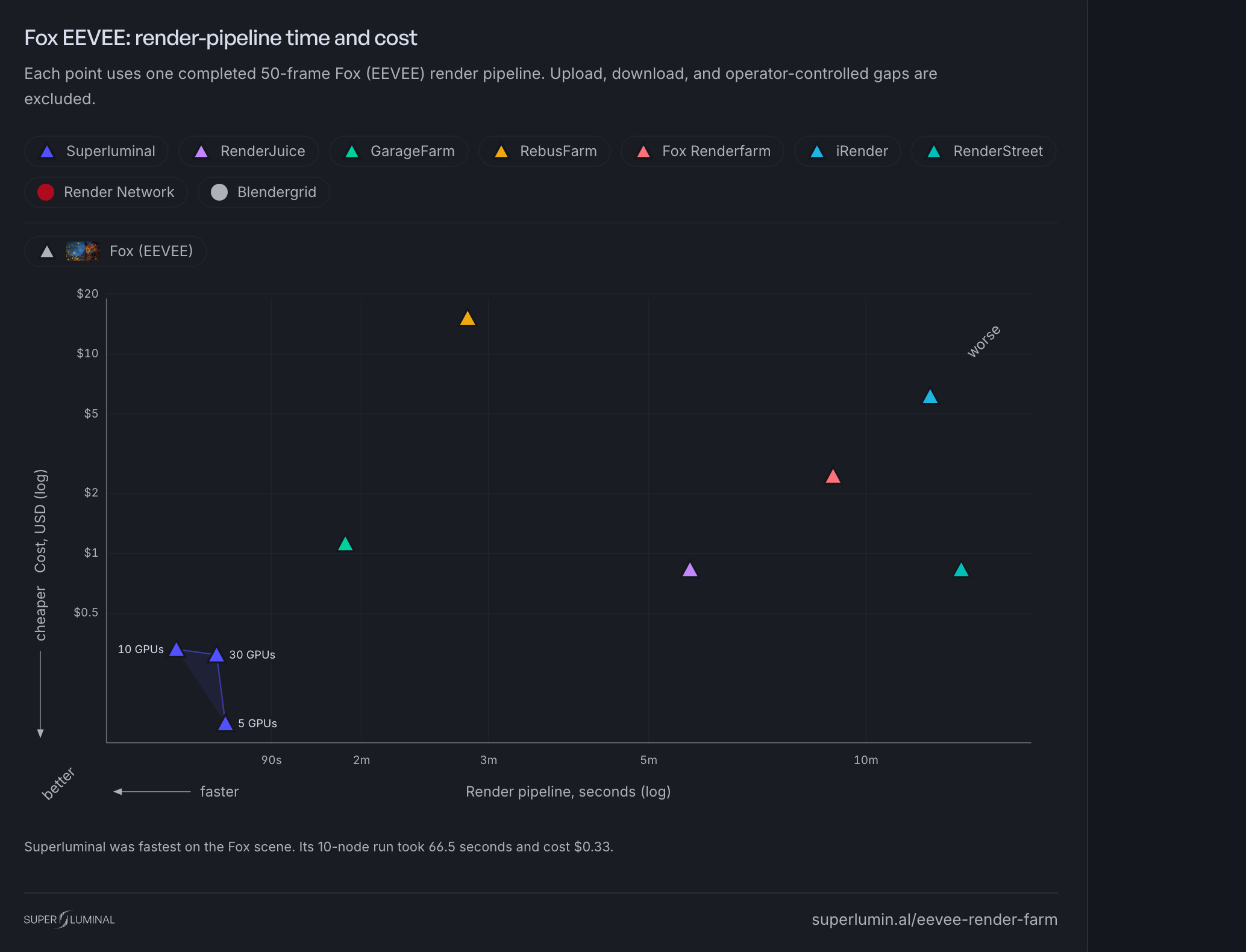
iRender's render pipeline finished 80.6 seconds after upload completed, but manual file synchronization took another 556.5 seconds. Its complete local output arrived 657.1 seconds after upload began. Fox Renderfarm delivered its complete local output after 579.8 seconds. RebusFarm rendered 50 frames, but its downloader saved only six locally.
Short frames make startup more important
Every node must start Blender, open the scene, prepare the frame, render it, write the file, and upload it.
These steps can take longer than the EEVEE render itself. The Persistence Engine can keep Blender open between frames and avoid repeated startup work.
See the process-reuse measurements.
Nodes split the sequence
Each node renders one frame at a time, so more nodes raise frame throughput. Bake simulations and other sequential caches before submission. Each node must be able to render its assigned frame without the previous frame.
Keep the Blender version and engine together
The benchmark sent the same base project to each service. Fox Renderfarm required the EEVEE device setting to be None.
Superluminal rendered the base project without that change. The farm version, engine, scene settings, and output format are part of the submitted job.
For supported releases and node controls, see render engine compatibility and render-node settings.